


In 1996, at the Roslin Institute in Scotland, a small sheep was born under the name Dolly. It was not just any birth, but rather the starting point of a new era in modern science. This is because Dolly the sheep would become the first cloned mammal from an adult cell. An achievement that represented a revolution in biology and opened a global debate about the limits of genetics.
Although her birth took place in July 1996, it wasn’t until February 1997, six months later, that the news spread around the world. Her arrival set a precedent in the history of biotechnology, as it proved that it was possible to copy life from an already differentiated cell.
However, her early death raised doubts and concerns about the viability and safety of cloning, as she died at the age of six, to the surprise of the entire world, which had been closely following the life and development of the sheep. Since then, questions have persisted, as if it were an unsolved case: Why did Dolly die? What did she die of? Is animal cloning viable? Below, we will try to answer some of the most frequently asked questions that arise when Dolly’s name comes up.
How was Dolly the sheep born?
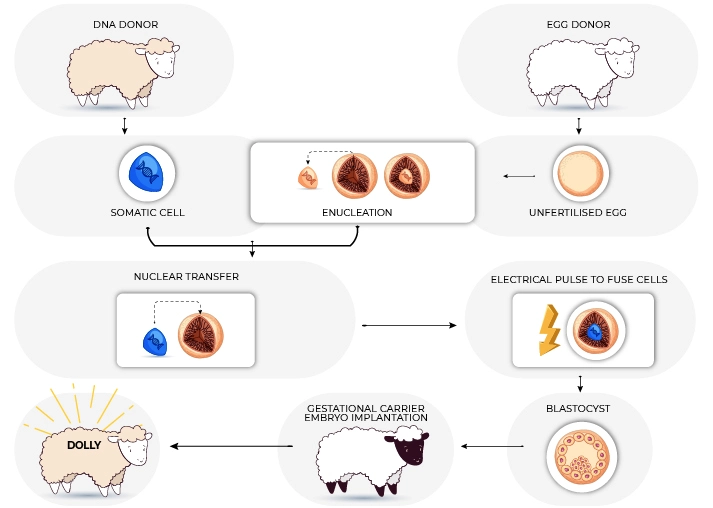
The birth of Dolly originated in a test tube at the laboratory of the Roslin Institute in Scotland. The research team had tried various methods until achieving success in 1996: the normal development of the embryo and its subsequent transfer to the surrogate mother.
Through an ultrasound performed 45 days into the pregnancy, the pregnancy was confirmed, as well as its fruitful progress. This surrogate mother was closely monitored to evaluate the process, which proceeded completely normally and with the same characteristics as a natural pregnancy. In this way, on July 5, 1996, the first cloned mammal in history was born through somatic cell nuclear transfer. From the very first moment, Dolly proved to be a vigorous lamb with no neonatal problems.
Evolution and development of Dolly
Su evolución y desarrollo fue normal. Tanto que los científicos del Instituto Roslin permitieron su reproducción natural. Se seleccionó un carnero galés de montaña como pareja y entre ambos procrearon seis corderos, todos con buena salud. El primero de ellos, de nombre Bonny, dio sus primeros pasos en la primavera de 1998.
Causes of Dolly’s short life and death
In one of the tests performed on Dolly the sheep —who was under close observation throughout her life— scientists discovered that the animal’s telomeres were shorter than expected for sheep of her age. This finding caused concern among those who had participated in the process of cloning the animal.
“Telomeres are DNA sequences found at the ends of each chromosome. When chromosomes replicate during cell division, information from the telomeres is lost, and they become progressively shorter as more cell divisions occur, leading to cellular aging. It was later discovered that telomeres are restored during the cloning process.”
However, they later determined that the speculation was false, since although Dolly’s telomeres initially appeared shorter than those of other sheep of the same age, they were not those of an old animal. Therefore, they did not conclude that the sheep suffered from any anomaly suggesting premature cellular aging.
An early and inevitable death
In the fall of 2001, Dolly’s caretakers noticed that she was walking with excessive stiffness. This raised suspicions, and she was taken to the Royal School of Veterinary Studies (RSVS). There, tests confirmed that she was suffering from arthritis. Once again, concern arose among the scientific team that cloned animals might be destined to age prematurely.
A specific daily anti-inflammatory treatment was applied, which resolved all clinical signs within a few months. Dolly had successfully overcome the diagnosed arthritis.
However, this was not the main cause of concern or the subsequent death of the first cloned mammal…
So… why did Dolly die?
In January 2000, Cedric, another cloned sheep, died with a clear autopsy result: ovine pulmonary adenomatosis (OPA). This is an infectious and incurable virus that induces the growth of tumors in the lungs of affected animals.
Concerned about a possible contagion, Dolly was isolated along with her first lamb, Bonny. A few weeks later, another cloned sheep from the Roslin Institute died of the same cause. This sheep had been in contact with Dolly years earlier, so the chances of infection were high. They became even higher—almost definitive—when one of her lambs was diagnosed with ovine pulmonary adenomatosis. The alarms were fully triggered.
It became a reality when they saw Dolly cough for the first time, in February 2003, confirming her lung disease. With no effective treatments available, the research team’s main goal was to ensure that if Dolly developed the disease, she would not be allowed to suffer. Daily health checks, veterinary examinations, and strict weight control were intensified.
Days later, on February 14, 2003, a scan confirmed that tumors were growing exponentially in Dolly’s lungs. Following this result, the team decided to administer an anesthetic overdose to end her life without pain or suffering.
Dolly, a scientific legacy
The birth, life, and premature death of Dolly the sheep represented a scientific legacy and a starting point for future mammal clonings. After confirming the cause of the sheep’s death, it was determined that the cell differentiation process is reversible, and the nucleus of an adult cell retains the potential to generate a new individual.
This paved the way for cell preservation and many advances and techniques that today are a fundamental part of the cloning process. Dolly succeeded in making the entire world talk about cloning, a new social paradigm, and laboratory innovations.